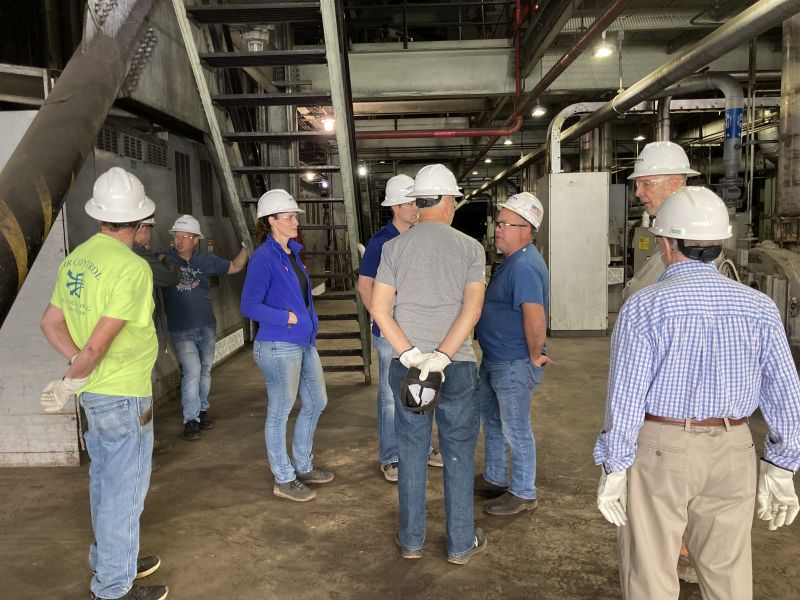
If you’re like most Sierra Club members, you don’t like coal. You’ve heard about how dirty it is, how bad it is for the climate, and that its more expensive than solar and wind. But these days, you can’t believe anything without checking for yourself, so a group from Sierra Club Miami Group visited a coal plant, organized by board member Larry Falkin. Here’s what we learned.
On Saturday, May 31, 10 Miami Group members toured the Miami Fort Generating Station in North Bend, Ohio. Our host for the tour was one of the plant operators, who has worked at Miami Fort for more than 25 years. He showed us everything, including the control room, the steam turbines, an aerial view of the barge facilities and coal stockpile. We even got to stick our heads inside the combustion chamber of one of the units that was shut down for maintenance. Everything about the facility was so big that it was hard to comprehend. The power generating equipment occupies a building more than 14 stories tall. Looking down on the coal pile from that height, the huge dump trucks moving coal looked like ants, totally dwarfed by the mountain of coal. The combustion chamber where the coal is actually burned is more than four stories tall, 50 feet long, and has dozens of nozzles that blow in powdered coal to feed the fires. The resulting heat is used to boil water into steam, driving turbines, which spin to produce electricity.
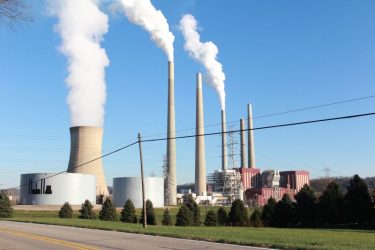
The Miami Fort Generating Station is celebrating its 100th birthday this year, having begun operation in 1925. The original units closed long ago. The two units that currently operate, Units 7 and 8, are about 50 years old. The facility burns about six bargeloads of coal every day and generates about 800 megawatts of electricity. It is scheduled to close in 2027.
It was interesting to hear the plant operator make the case for coal. In 1975 when the current generating units were built, there were no better options for generating electricity, and climate change was not on anybody’s radar. These units started out dirty, for sure, but over the decades, huge amounts of money have been spent to make it cleaner. The facility has sophisticated equipment to remove NOx, sulfur and particulates from the exhaust gas, reducing the emissions of conventional pollutants by about 99 percent. The plant operator reminded us that all of us use electricity, and all of us expect that electricity to be available 24/7. When we flick the switch, we want the lights to come on. If all coal in Ohio were shut down today, there would not be enough other electricity available to meet the demand.
By today’s standards, coal may be dirty and expensive, and soon we may be ready to live without it, but its hard to fault the decisions made in 1925 and 1975 to build it, nor the decision to keep it on line until the demand for energy can be met without it. The use of coal to generate electricity in the United States is dropping rapidly and may soon disappear altogether. “I, for one, will cheer that day and do everything I can to speed its arrival,” Larry Falkin said. “But having visited Miami Fort, I have a new appreciation for the role that coal has played in fulfilling my wants and needs, and probably yours too.”