
The Sierra Club Ohio Chapter Legislative Committee Updates cover important bills currently in the Ohio General Assembly. We welcome your comments and your help as we work together to build strong, empowered communities in Ohio.
Community Energy in Ohio
Municipal Resolutions in Support of House Bill 303
Municipalities across Ohio are passing resolutions in support of House Bill 303. Here are a few reasons that city councils feel it is important to send a message to our Ohio General Assembly asking for HB 303 to be voted on and passed.
Energy Costs: We have seen steady increases in our electric bills and our cost will likely continue going up, making it harder for everyone to be able to afford the basic necessity of electricity.
Community energy as described in HB 303 allows residents to save money on their electric bills by subscribing to energy sources like solar arrays that may be placed a distance from their homes. Community energy opens the door for homeowners who can’t or don’t want to install solar on their roof to save on their bills. HB303 allows renters to subscribe to solar arrays and to save money.
Community Health: We know the negative health effects caused by the extraction, transport and burning of fossil fuels. Low birth weight, preterm births, congenital anomalies, asthma and childhood cancers have all been linked to living near oil and gas infrastructure.
We need an alternative to fossil fuels to protect our health and the health of our neighborhoods. HB303 could safeguard our community health by providing an avenue to build safe, small-scale solar energy generation.
Community Energy: HB 303 allows for modest sized energy generation on our local grid. With this bill we can get solar energy built and connected quickly and locally!
Local buildings, schools, and libraries could be powered with community energy. Empty roofs and parking lots could be providing energy to our neighborhoods and saving money for everyone in the community.
The policies proposed in HB 303 have been proven to be effective. Twenty-four states are already successfully using community energy to save on costs, to generate clean electricity, and to build their local economies.
HB 303 would also benefit organizations like The Cleveland Solar Cooperative. The Solar Coop is a group of neighbors who’ve come together to build Community Owned Solar – a slightly different model that also achieves the shared goal of clean, safe, solar energy generation. Community Owned Solar involves pooling our money to buy and own solar arrays, and working with local businesses and community organizations to host our arrays. With the Cleveland Solar Coop model everyone saves and the money stays local!
Ohio House Bill 303 would also open up opportunities for organizations like the Cleveland Solar Coop to build arrays and would make it easier for organizations like the Solar Coop to invest in our communities.
HB 303 passed the Ohio house in November 2025 by a wide-margin. It had full support in the House Energy Committee and passed on the House Floor with a 77-8 vote. This bill has broad bipartisan support and addresses real needs for our city. It offers something for everyone – ratepayers, businesses, homeowners, renters, and municipalities – all benefit from a stronger local economy.
It is important for cities to speak up in favor of good policies in Columbus. A sample resolution is linked here. Consider talking to your local government about supporting House Bill 303.
Bill Tracker
The Ohio Legislative Committee is tracking these bills. Please consider talking to your state senator or representative about these proposed pieces of legislation.
The Ohio Chapter supports HB 303 – Establishment of community energy program and pilot program.
House Bill 303 would authorize and create a pilot program for community solar energy in Ohio. Community solar would allow Ohio residents to subscribe to offsite solar energy projects without the need for individual rooftop capacity or financing. Community solar has the potential to greatly expand access to clean, renewable energy for thousands of Ohioans.
The Ohio Chapter supports HB 439 – Prohibit the surface application of brine from oil and gas wells.
House Bill 439 would prohibit the surface application of brine from oil and gas wells. In Ohio brine from oil and gas wells may still be legally used for de-icing roads and dust control. Brine from oil and gas wells contains a number of pollutants, including radioactive material, and its use is environmentally harmful.
The Ohio Chapter supports HB 755 – Regards portable solar generation devices.
House Bill 755 would authorize the use of certified portable (balcony) solar devices in Ohio. House Bill 755 can be thought of as a companion to HB 303, the Community Energy bill. Both bills would expand access to solar resources for individuals across Ohio. Portable (balcony) solar is already popular in other parts of the world, but it is relatively new in the United States.
Portable, “balcony” or “plug-in” solar devices are designed for renters or homeowners to mount outside the home and connect directly to standard 120-volt wall outlets using inverters. Generally, users can see a 10-30 percent reduction in energy costs. Utah recently became the first state to explicitly authorize portable solar, and a number of other states like Ohio are considering following suit. By allowing the use of these portable devices, Ohio would knock down one of the remaining barriers to the widespread adoption of solar power.
The Ohio Chapter supports HB 399 – Prohibits fracking under our state parks and SB 132 – Prohibits both fracking under state parks and extraction of oil or natural gas from under Lake Erie.
The Ohio General Assembly and the Ohio Oil and Gas Land Management Commission are leasing our state parks for toxic fracking operations. Approximately 12,000 acres of public lands in state parks and wildlife areas have already been leased for fracking. This extractive industry threatens the air, water, and soil in and around our parks and wildlife areas, and puts our communities at risk. The Sierra Club is opposed to oil and gas extraction generally, and especially in sensitive environments and areas that are accessible for recreation.
The Ohio Chapter opposes HB 170 – Establishing a process for carbon capture and storage technology.
HB 170 would authorize and provide a regulatory structure for carbon capture and storage projects in Ohio. This bill would authorize the operation of underground carbon sequestration projects in Ohio, using carbon dioxide injection wells. The bill would preempt authorities other than the state Division of Oil and Gas Resources Management from exercising regulatory authority over underground carbon sequestration projects. The bill would also generally exempt injection well operators from liability associated with the carbon sequestration projects.
The bill would encourage more oil and gas activities in Ohio by providing carbon “offsets.” The regulatory system proposed in this bill is weak and porous, and it would be overseen by lawmakers and an agency with a poor track record of protecting human health and the environment.
The Ohio Chapter opposes Senate Bill 219 – Revise the law governing oil and gas well.
Senate Bill 219 would expedite the review of drilling permits, curtail the authority of state agencies, and increase the length of basic oil and gas leases.
Senate Bill 219 is a laundry list of giveaways to the oil and gas industry. The bill would make it easier for oil and gas operators to drill new wells, to keep those wells open longer, and to avoid responsibility for waste and orphaned wells. The bill would add bad provisions to an already terrible Ohio energy policy.
The Ohio Chapter opposes Senate Bill 294 – Declare the State’s energy siting policy.
Senate Bill 294 is clearly designed to provide advantages to natural gas projects and disadvantages to renewable energy projects in the certification process. The bill again defines natural gas as a “clean energy source.” The broad nature of the bill language can be interpreted to serve different interests. One analysis of the bill notes that its preference for energy projects with a “minimum capacity factor of fifty percent” would disadvantage wind (34 percent) and solar (23 percent) and it does not provide for consideration of battery storage when determining the reliability of a power source. SB 294 is intended to put renewable energy further behind in Ohio, and to continue the legislature’s efforts to prop up natural gas.
There is already a groundswell of opposition to SB 294 from organizations that we ally with on energy policy.
Join Our Legislative Team!
The Chapter Legislative Committee meets online monthly on the first Wednesday at 6pm. Check the Ohio Sierra Club Calendar for links and updates.
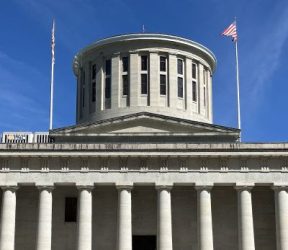
Photo credit: Capitol Square Review and Advisory Board
